Mikaili Green ’26
The first thing I remember noticing when I arrived in Baltimore is how the heaviness of the environment was so apparent. On the way in, I saw a homeless man wave at us. He was not holding a sign or asking for anything, just waving. It stuck with me as it felt more “human” than a lot of the other things that I saw around him.
Parts of Baltimore itself felt very dense and worn down. Trash filled the streets and sidewalk – mostly cans, plastic bags, and newspapers; however there were a multitude of other types of trash littering the ground. Graffiti was everywhere, covering the sides of buildings and rooftops. The row houses made up most of the landscape of the city giving it a sense of density and repetition. The sky above was gray and overcast, making Baltimore feel somewhat “frozen” in time as if it was all built at once and then abandoned.
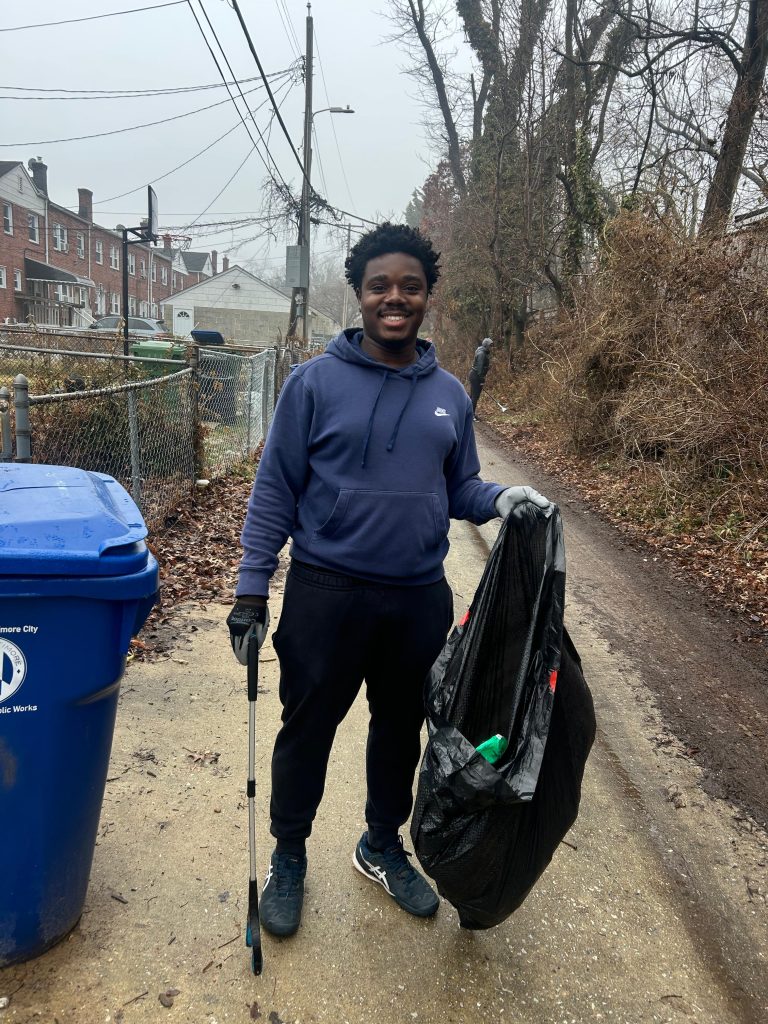
Yet at the same time, it didn’t seem like everyone was being completely neglectful. While moving through different streets of the city I noticed that the housing appeared to be visible evidence of varying degrees of care and detail and efforts, regardless of the apparent poverty in the surrounding areas. This contrast caused me to begin taking notice. The conditions surrounding me were not appearing to occur randomly; they were beginning to appear to have patterns.
We arrived at Govans Elementary School and began driving around the area collecting trash. What we collected would further illustrate the condition of the surrounding neighborhood. We found numerous pieces of trash including cigarette butts, food wrappers, broken plastic items, glass bottles and various forms of miscellaneous waste. At one point, we even found a pile of credit cards in a drain. Someone also found a shower head.
While the wet conditions made it harder to pick up litter than I thought it would, the act of picking up trash itself made dealing with those wet conditions much easier to handle.
In addition, while I was able to observe the neighborhood in a way I wouldn’t have if I hadn’t participated in the cleanup, there was also some value in being physically engaged in the neighborhood’s care, even in such a small way.
A greater depth of meaning was added to my involvement when I heard from Marc Carr, the person who sponsored this project. Marc is a church deacon and serves as the Director of Special Projects at Ashoka, a non-profit organization whose mission is to support social change leaders. What struck me the most wasn’t simply Marc’s title, but the manner in which he described why he engages in this type of work. He noted that both of his parents were very involved in their community and that his father worked for a non-profit organization for 40 years. As a result, Marc has always seen community engagement through the eyes of family example. Marc has also been personally involved in activism since high school, including working with a group called SEED (Students Envisioning Equality through Diversity) at his alma mater. When I listened to him, it was apparent that Marc’s understanding of justice is not abstract; rather, it has been shaped by a combination of family example and personal experience.
Marc helped me to see that what I saw in Baltimore cannot be simply attributed to the individual choices people make, nor can it be reduced to visible evidence of neglect. According to Marc, the fundamental cause of what I observed in Baltimore is systemic racism. He discussed how Baltimore served as an early prototype of racially-based disinvestment using systems such as restrictive covenants and redlining. Communities of color in Baltimore were systematically denied investments and the impacts of these decisions did not remain limited to housing issues. Rather, they affected opportunities for education, social mobility, access to food, and economic development. What I initially perceived to be signs of neglect in the neighborhood took on new
meaning when Marc provided insight regarding the underlying structures that led to these problems. I knew that they existed, and that these systems were in Baltimore, but was unaware that Baltimore was the origin point. The trash, the uneven housing conditions, and the general feeling of abandonment were connected outcomes of a long racial history.
One part of Marc’s explanation that we spoke about often in class was how economic conditions affect the food environment. When employment is low, or when there are no job opportunities, consumers will often seek out the lowest cost food possible. Consequently, the types of businesses that can survive in this type of market are usually the cheapest providers (e.g., corner stores), and not the healthiest options. Witnessing this in person helped make food insecurity more tangible to me, because while availability of food is an issue, the quality of the food and what types of jobs/income/financial investments help determine what food is available in the first place, is just as important. I’m not unfamiliar with food insecurity by any means, but I’ve also never witnessed it to this degree.
The most important thing I took away from Marc, though, was his perspective that the community does not have to be a victim of these systems forever. Marc identified the Black church as one of the community’s greatest resources due to its ability to promote collectivism and trust. He stated that creating access to land and growing food collectively could create both food security and community empowerment. For example, at the Dewees Community Center, residents can reserve garden plots and learn from each other and produce their own food. He discussed how the York Road area is a physical dividing line between Black and White communities, which made the geographic inequalities we see today seem so much more real. He also discussed how the York Road Partnership (which brings together 17 neighborhoods of varying degrees of investment) is
working to bridge the divide between the two communities to work collaboratively to redefine development and ultimately give back control of redevelopment to the communities themselves. Ideas such as crowdsourcing funding and allowing residents to vote on where the money is spent are indicative of a new model; one in which redevelopment is not a decision made for a neighborhood, but rather a process created by the individuals who live within it.
My view of what I saw at the end of the day was very much changed; my first view of Baltimore (and its obvious decline) was replaced by a new, more complex image as I spent the day helping in the neighborhood with Marc. The disorder that was evident in the area had a story behind it; the abandonment that was apparent was home to many people who were fighting to grow, protect, and restore their community. On the first day, I learned that you can’t just see a location and think you know it based upon your sight alone; you need to ask yourself, “Why did things develop this way?” Who has been denied access to resources? And who continues to fight for positive change in their community despite the fact that the odds may be against them? That was the biggest lesson I was able to learn from my time in Baltimore: community transformation does not start when
the circumstances are optimal. Community transformation starts when enough individuals within a flawed or unfair system choose to take action together.