Maya Fetzer ’26
I always thought lobbying was only when a rich man in a fancy suit told politicians to change legislation in exchange for campaign donations. I would have called all lobbyists evil people. However, today’s journey to Capitol Hill showed me that lobbying is a tool in an organizer’s tool belt to make long-term, systemic change that can help bring power to individuals who need to see sustaining changes.
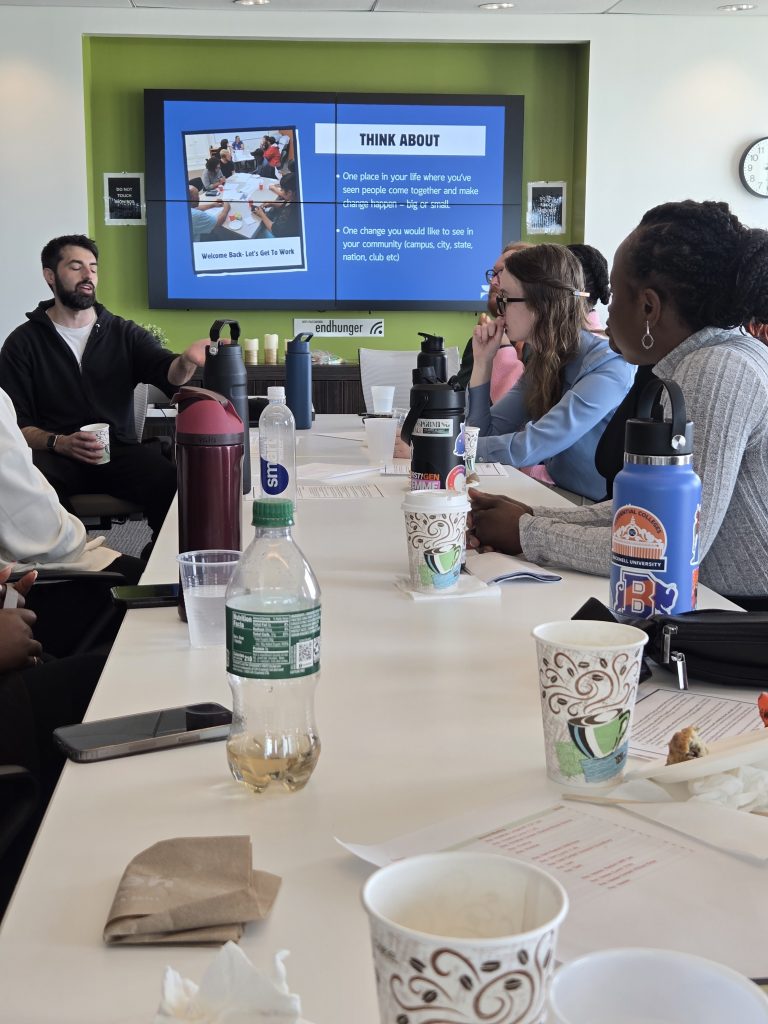
Today, we met with Bread for the World, a faith-based advocacy organization urging U.S. decision makers to do all they can to pursue a world without hunger. Their mission statement is to educate and equip people to advocate for policies and programs that can help end hunger in the U.S. and around the world. We met with Robb Friedlander, a strategist who specifically focuses on how to empower college age students into sustainable political action around food insecurity on college campuses. He brought us to Capitol Hill to meet with three congressional representatives and encourage them to continue to support policy that will help reduce the SNAP gap in college students as well as improve international funding after the cuts to USAID.
Following this experience on Capitol Hill, Robb taught us how to organize and strategize as students on college campuses. Many college students fall into the same trap when organizing movements — they protest, then just go home. Students are mobilizers: we show up in large numbers, are passionate about improving the world, and then often leave it at that. In terms of pushing for legislative change through meaningful action? Students aren’t usually very good at that. Robb taught us that to do this, we need to dissect our big idea into actionable steps by tracing power structures and identifying accountability. He walked us through the process of identifying the specific change we want to see, who has the power to make that change, and who influences those decision-makers.
This experience changed my perspective on what it means to be politically active; it isn’t just protesting. Now, I understand that protesting is just one tool in the tool belt of making change. To be both change-makers and change-sustainers, we need to organize, plan strategically, use our resources, and build purpose within our organizations. Today also helped me see how college students can take real action on our campuses to address food insecurity. There are meaningful ways we can advocate for students struggling in the SNAP gap while also supporting policies that help people facing hunger around the world. Today reminded me that solving issues like hunger requires more than compassion. It requires strategy, organization, and persistence to make meaningful change last.