Omuhle Ndhlovu ’27
In Baltimore, community members are not waiting for another bill to be voted on or another policy to be debated before people’s dignity can be restored. They are confronting injustice with something no one can take away from them: their own power.
They are not asking for permission to create change. They are showing the unwavering power of Ubuntu (the belief that our humanity is bound together), and so in restoring others, we restore ourselves.
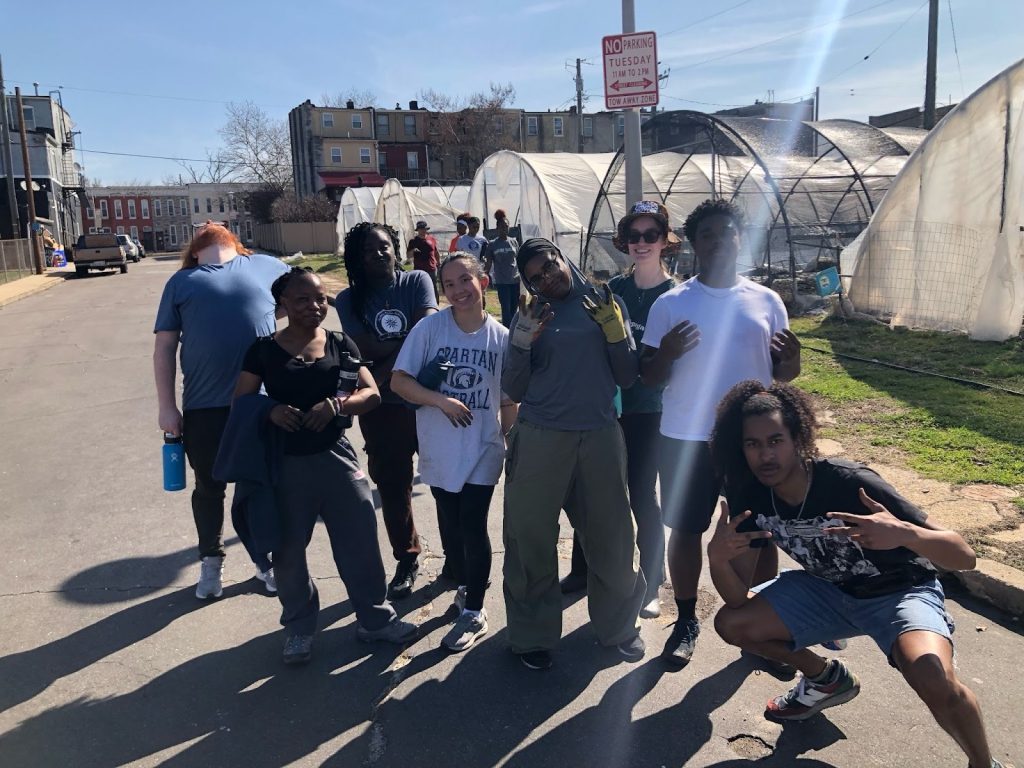
Near Govan Elementary School, Marc sees the trash and litter in his neighborhood as an opportunity to build meaningful connections within the community. Reverend Heber captures this spirit when he says, “The Avengers are not coming to save us… we are our own heroes.” Through the Black Church Food Security Network, he is shifting the status quo in Black communities across the United States through gardens owned and run by local residents, transforming how communities access food.
At Strength to Love Farm, Shea McCoy and Corey are growing vegetables in a food apartheid neighborhood. They are filling a gap that grocery stores refuse to address because profits would be too low. In class, Kurt once reminded us that “we depend on a profit-driven industry to provide us food.” Access to food should never depend on profit margins. The real question should be: How do we ensure that every resident lives within a reasonable distance to fresh, healthy food?
My favorite part of this experience was witnessing the intersection of faith and food justice.
At Liberty Grace Church of God, Terris showed us how the church reimagines its role in the community. The building is alive with activity — a café upstairs, cooking classes in the basement, workshops and educational programs for children. The philosophy is simple.The church is part of the world. So the church should serve the world around it.
At the Islamic Society of Baltimore, we broke fast with the community and learned how the mosque supports those around it. Free meals are served in the cafeteria, funded through charitable giving rooted in the Qur’an, the Mosque also provides educational programs.
At Beth Am Synagogue, Gregory introduced us to the synagogue’s food pantry and distribution programs. Over a shared meal, we learned about the Jewish faith and its deep commitment to serving those who are hungry, poor, or strangers.
Seeing that religious institutions continue to play a powerful role in building systems of care and solidarity was healing in a way.
It reminded me that change does not always begin in policy rooms or government buildings.
Sometimes it begins in gardens. In churches. In mosques. In synagogues. In communities.
It begins in us, the heroes we are waiting for look just like us.