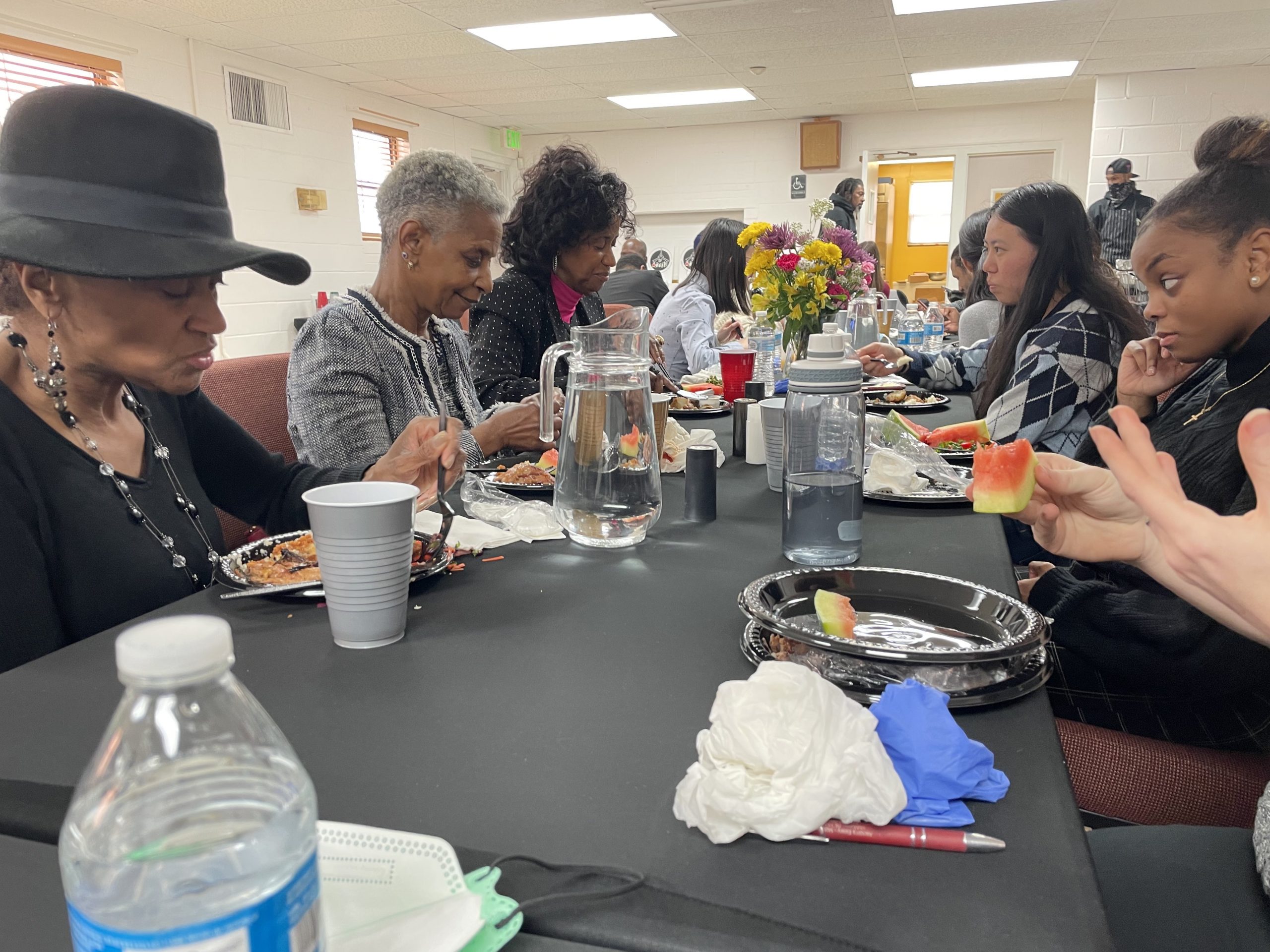
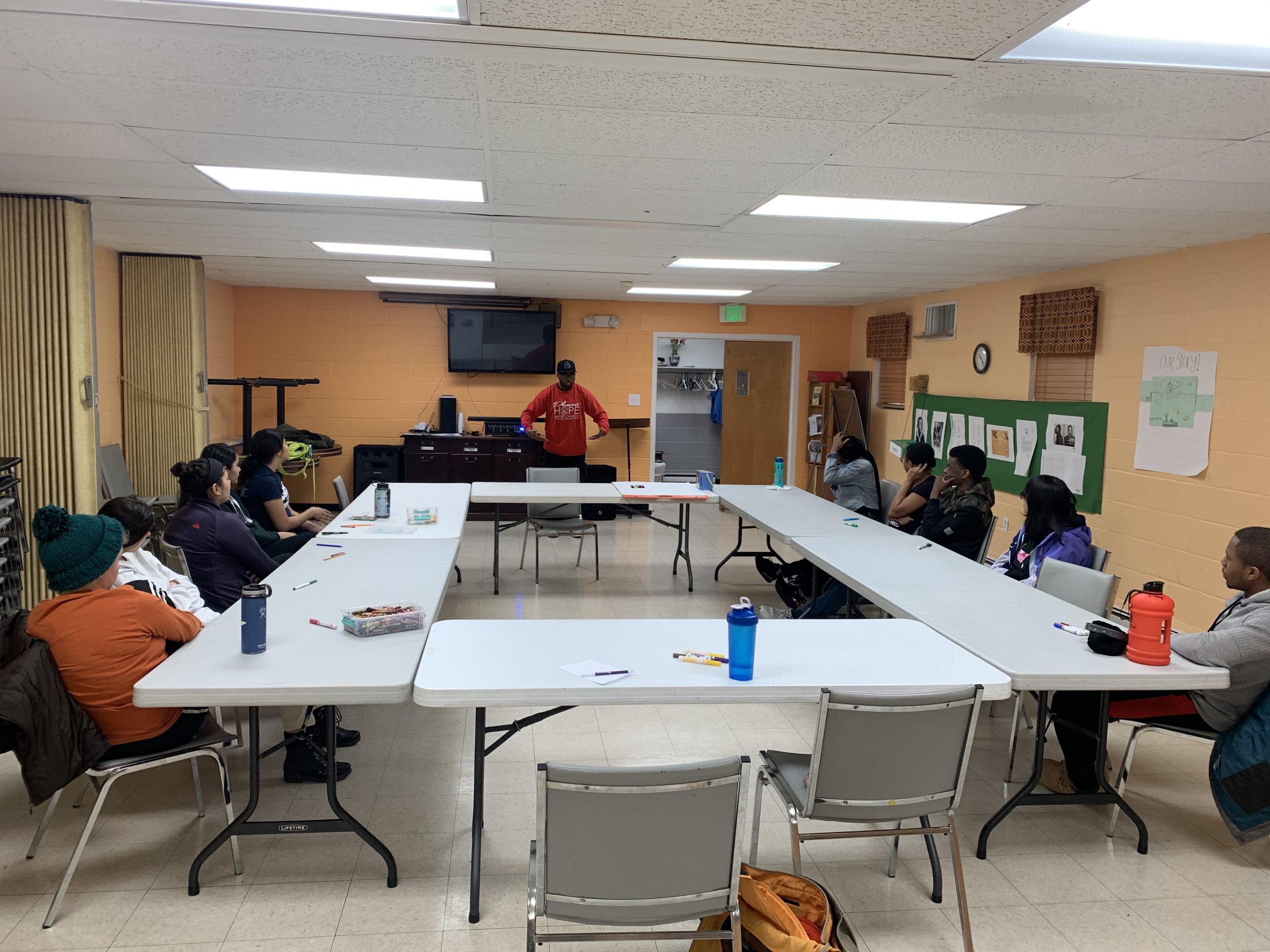
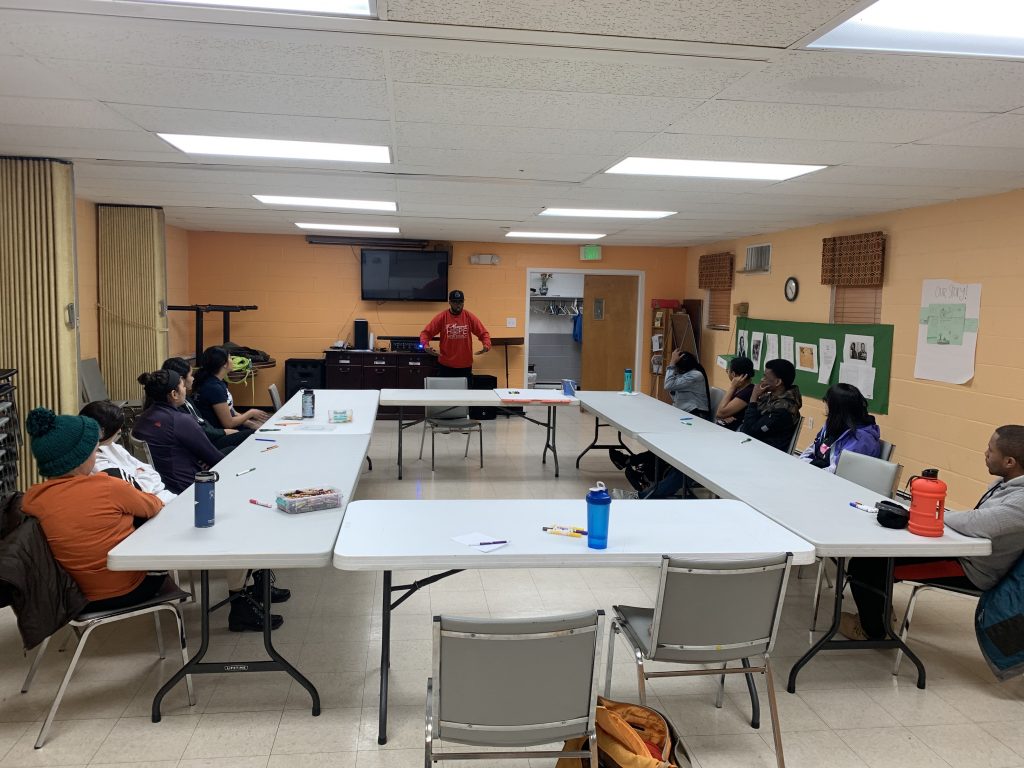
Today we visited Pleasant Hope Baptist Church where we had breakfast at 9 am and were pleasantly welcomed with open arms. It honestly felt like I was reconnecting with my lost cousins as they comfortably welcomed us without any hesitation. Everybody introduced themselves in passing along with taking the chance to get to know us. The day served as a follow-up to the previous day in which we had a warm introduction on the prevalence of anti-blackness and its connection to the environment, not quite getting to what this meant for the functionality of the Black Church Food Security Network.
After two years of pandemic, we’re headed back to Baltimore with a wonderful group of students and scholars this week. We’ll post regularly from our service-learning course experience here. Stay tuned!
What do we do now? Food insecurity is everywhere. Many people fail to acknowledge how it looks like or what it really means. We tend to ignore these issues and make several assumptions about them. This trip to Baltimore really opened my eyes even more to those food insecure and what they have to go through every day. From being volunteers at Our Daily Bread to getting to learn how different religions tackle the issue of food insecurity, it’s time we recognize what we can do to help.
I was able to have the wonderful opportunity to meet with several non-profit organizations and see their POV in all of this. As long as we work together and acknowledge that food insecurity is real, is when we can finally make a bigger change. All these non-profit organizations have done their part, and we should start doing our own. Whether it’s volunteering at a soup kitchen or donating food, we can all come together to make a greater change in this world regarding food insecurity. All it takes is the right motives to help and put forth the effort.
Team Empanada, coming through with dinner prep.
We want everyone to have the opportunity to have nutritious food and with doing so, helps them in the long run. Being on this trip has taught me to always help in ANY way you can. It has also taught me that the connections and relationships you build with other people really makes a difference to come together and tackle this issue. I was able to get to know my group a little bit better and in what ways they are involved with helping those food insecure, and I am grateful for that. I also wanted to say thank you to our Chaplain, Kurt Nelson, for giving us this great opportunity to build connections with others and learn the various ways people from different organizations have helped to minimize food insecurity. Unfortunately, we will not be able to meet face to face with our group for the remainder of the semester, but this trip definitely motivated us even more to help bring awareness of the truths of food insecurity to our own communities and make a difference. Now, I’ll ask you this. What will you do?
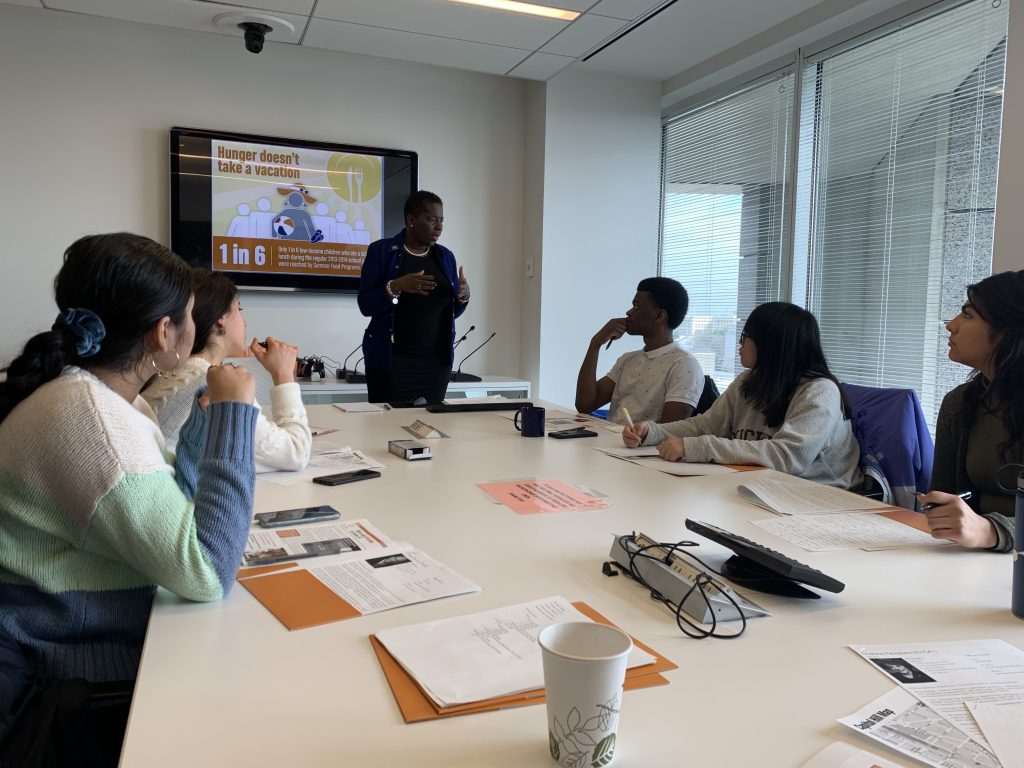
Here we are at Washington D.C., my most anticipated day for this whole service trip. Amidst the news of Bucknell closing we go into the chaos that is Capitol Hill. From the frying pan into the fire as they say. We wake up early, zoom through preparing ourselves for presentation and the frustration of our roommate waking up early. Then to the bus, the train station and finally D.C.! We arrive at the building and my heart kinda stutters but then picks up, a common theme for the day. We’re put into this conference room with a representative of Bread for the World, Jacob, who walks us through the organization’s objectives. With a little foreground of what we’re advocating for, a pinky nail of the U.S.’s GDP ($50 Million), Chonya Johnson walks in.
The issue of food apartheid in Baltimore is not a result of organic processes but rather a product of intentional policies and structures. To this end, our meeting with Alice Huang, a food access planner at the Baltimore Food Policy Initiative, was particularly interesting since we were given a glimpse of how policies with the goal of combatting food insecurity operate.
When listening to Alice, it became apparent that you can’t discuss food without also discussing social groups and their respective dynamics. She introduced us to the concept of triangulation where two non-white groups fight each other for resources. One pertinent example includes the black population’s disapproval of immigrant-run corner stores. The divisions made amongst these groups is unproductive and leads to additional struggles when attempting to implement solutions since coalitions between those groups are unable to be made. In some ways, it becomes a drain on the effectiveness of a solution implemented since the groups are fighting the wrong enemy. Alice also highlighted that the food conversation, while being predominately white and black centric, leaves out minority groups like Asians and asks where those voices go.
This question, in particular, is something I grapple with often when thinking about how social justice and diversity initiatives are structured. When reflecting on all the visits and discussions of the week, it is absolutely clear to me that tackling the issue of food insecurity in Baltimore requires a multi-pronged approach. You know you are doing it right when you understand the history involved and prioritize the voices of the affected.
t’s day five at the Food inequality service trip in Baltimore, MD. As part of the Bucknell university course, Food, Faith and Justice, seven individuals including myself visited several religious institutions (Sikh Association of Baltimore, Islamic Society, Black Church Food Security Network), community farms (Little Portion Farm, Baltimore Farm Alliance) and a soup kitchen (Our Daily Bread). The object of this trip was to become accustomed to the many issues facing Baltimore – homelessness, the lasting effect of red lining and most of all, individuals struggling to obtain sufficient sustenance to go about their daily lives.
We initially met with Dr. Surinder Singh Gill to inquire about his project in helping immigrants and those in the Sikh community in having a stable community. In Sikhism he mentioned how when sharing meals, all individuals despite race, religion or socioeconomic status must sit in line side by side as a means of showcasing how all are equal. This similarity is also present in Islam as when Muslims come together to have their required prayers, all must prostrate in the presence of God; thus, further showing the equal nature of everyone despite their differences. Along with this concept I further learned of the concepts in these religious faiths: a) Baptized Sikhs must never cut any part of their body hair and must remain vegan b) Muslims must uphold the principles of their religion, many of which focus on the importance of society and the need to aid those less privileged.
On Tuesday, our group visited the Pleasant Hope Baptist Church and spoke with the Rev. Dr. Heber Brown III, who informed us of the initiatives that his parish has taken to address issues pertaining to food insecurity. Pastor Brown mentioned that they developed the Black Food Security Network, where they have a community garden and a fresh farmers market with produce from their garden. Pastor Brown described that the name emphasized his desire to serve his community specifically; it didn’t necessarily mean that it was an exclusive group, but it did mean that it was created with the focus of his community in mind. At Pleasant Hope, we had a fruitful conversation with Pastor Brown about how he has had the opportunity to move on to another parish, and time and time again he has rejected the offer because he wants to be around to help his community. What was important to him was being there for his community and making sure they got the help and support that they needed within their community.
Through the duration of this trip, one of the things that has stuck with me is Pastor Brown’s words, where he said, so many times people think they’re going to work a job until they get the money they need to help their community, and once they realize they finally have the means to give back, 45 years of their career have past and they’re onto the next chapter of their life. This trip leaves me with much to think about; as I continue my educational endeavors, I realize that these issues pertaining to food insecurity that have been prevalent in my own community in Los Angeles will not stop and wait until I am available to help them. It is an ongoing struggle, and one that needs immediate change. This leads me to ask what can I do now to start working towards the change I want to see in the world? In my community? I would be lying if I said this hasn’t made me reevaluate my long term career goals and what my priorities are. Pastor Brown’s words have reminded me to remember where I came from and be the change that I want to see in the world.
This world we call grand is so minimal in its existence. Both in the universe and within our collective existence, we learn that the Earth is much smaller than some humans conjecture.
Tuesday morning was a revitalizing morning to a strenuous Monday afternoon of farming and agricultural practices. We had a cogent conversation with Black Church Food Security Network at Pleasant Hope Baptist Church and their endeavors providing food justice to the local black community. Rev.Dr. Heber Brown was a strong amalgam of energy, knowledge and spirituality. His profound understanding of the economics, psychology, policy, and social dynamics of food insecurity and food justice made his abundant energy more inspiring. From the moment we stepped off the bus and was introduced to Shav’Von, I knew we were in the presence of change makers – black change makers. Clearly, I stress race because I believe Bucknell has problems tackling race issues and I constantly feel uncomfortable conversing with some people; this was a break from that discomfort.
As Heber talked, I was astonished at the disseminating knowledge and constant progression this church provides for Baltimore citizens.
As we engaged with Heber, I only thought of Philadelphia and my church, St. Paul’s Baptist Church. Immediately, I knew that our congregation had to adopt some of the strategies and collaborations that Pleasant Hope has. Thankfully, Heber and my pastor, Dr. Leslie Callahan are acquaintances! I was astonished to have made such a great connection and have been part of an important moment for food justice in Baltimore and now in Philadelphia.
I hope to continue my journey as a nutrition and behavioral health advocate and change maker because I cannot stress the importance of these health disparities. With the help of Pleasant Hope, St. Paul’s. Philadelphia local officials and a gritty attitude, maybe food insecurity can be mitigated in my city as well.
We were greeted by Fr. Mike at the gate of the Shrine of St. Anthony, a Franciscan shrine located 30 miles west of Baltimore. Even before stepping foot into the shrine, one could hear birds’ chirpping from all directions and cows’ mooing in the distance. Fr. Mike guided us through the sanctuary before inviting us to sit in the library to talk about the history, believes, and actions on reducing food insecurity taken by the shrine.
What I found interesting personally, though not directly related to food, is the Franciscan way of viewing nature as someone who supports us and whom we need to support like as family. He pointed out that nowadays we human counterposes ourselves from nature, saying things like “man vs wild”, when in reality we are part of nature. It is essential that we position ourseves appropriately in relation to the Earth, so that we can always be grateful to what we have now and remember to give back.
After lunch, we worked in the Little Portion Farm ran by the shrine to help prepare for the coming spring. The Little Portion Farm was created as an attempt to both bring people closer to nature and provide fresh produces to serve those who are in need. Every year different types of crops such as potatos, lettuces, tomatos and more are harvested and delivered to the Franciscan Center in Baltimore for distribution. Fr. Mike, when explaining the objective of the farm, quoted from Pope Francis: “to hear the cry of the Earth and the cry of the poor.” Even though the project is still in its developing stage, there are clear visions and plans to create an ecosystem where human and nature can work hand in hand to combat food insecurity in Baltimore area in a sustainable manner.
We’re finished with our 3rd day of our Food, Faith, & Justice spring break trip – the culminating experience of our course. More posts to come from student participants. But from me (Kurt) tonight: We finished our second hard day of labor – working on community gardens, and got to meet with one of my favorite people – the Rev. Dr. Heber Brown III today – founder of the Black Church Food security network.
Lots more to say later – but as we arrived home – sweaty and tired – we learned that the end of the spring semester at Bucknell will be radically altered, as an effort to keep everyone safe from Covid-19 outbreak.
Emotions ranged widely, but everyone was worried about next steps, storage solutions, ends of classes, etc. We pondered and wondered and consoled. But then we stopped for our nightly student-led reflection. And for a few moments, we considered those who don’t know where their next meal is coming from and considered those responding so meaningfully to the challenges here.
And in the midst of it all, we had a moment of profound learning and community. Asked to reflect on the day, off the cuff, in haiku form two of our group responded:
Critique what is Create what should be Lead from what you have
(Lessons from Pastor Brown) and:
Be proud of who you are persistence is key Marathon, not a sprint.
I don’t usually stop mid-reflection to take notes, but I had to.
Mostly, what I feel this evening is gratitude l to travel and learn with such amazing students. Gratitude for our amazing community partners. And deep grief that I won’t see our students as we return to campus.
Sending much love this evening to the Bucknell community from Baltimore – especially the members of the class of 2020. Stay tuned.
At Pleasant Hope Baptist Church with Sha’Von and Pastor Brown